
Neurofeedback: The Science of Neuro-Regulation
At Healing Tree Counseling, we don't just manage symptoms; we address the physiological source. Neurofeedback is a sophisticated, research-proven method of retraining the brain to function at its highest potential through Neuroplasticity.
By monitoring brainwave activity in real-time, we provide your brain with the feedback it needs to "rewire" itself. This process, known as Operant Conditioning, helps the brain transition out of stuck patterns of dysregulation and into a state of balance and resilience.
The Foundation of Operant Conditioning
The science of Neurofeedback is rooted in the late 1960s with Dr. Barry Sterman’s research at UCLA. Sterman demonstrated that brain rhythms could be conditioned via Operant Conditioning—a learning process where the brain is rewarded for reaching specific, healthy frequency targets.
At Healing Tree, we monitor your brain’s electrical output (EEG). When your brain hits the target "healthy" frequency, the visual or auditory reward (such as a movie playing clearly) continues. When the brain drifts into dysregulated patterns, the reward is inhibited. Over 20–40 sessions, the brain adopts these healthy patterns as its new "default" state.

The Feedback Loop: Sensors read activity → Software processes signal → Brain receives reward → Neural pathways strengthen.
Understanding Your Brainwaves
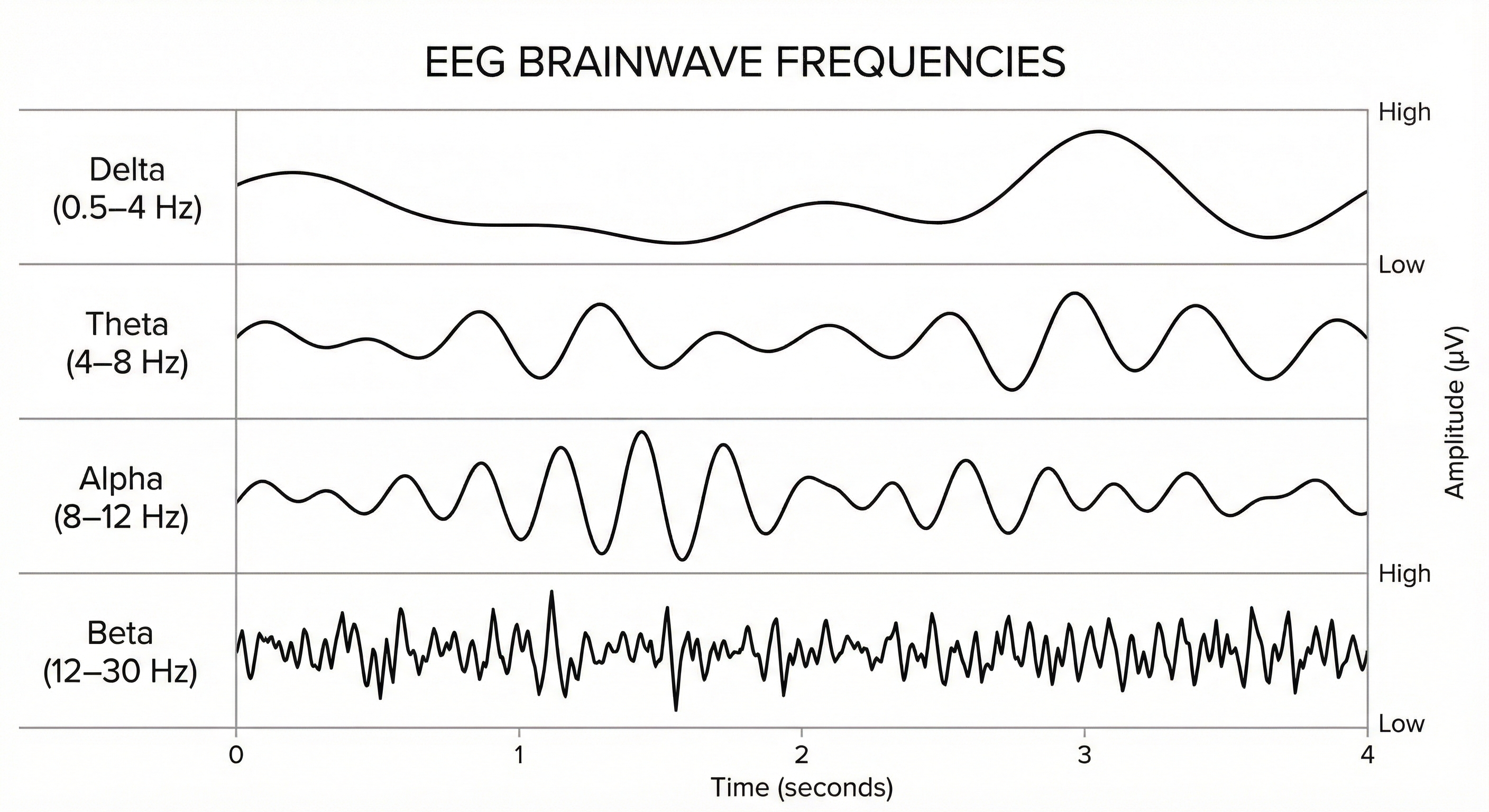
Every thought and emotion is an electrical event. We monitor these events across a specific spectrum of Hertz (Hz) frequencies. When these are out of sync, clinical symptoms emerge:
- Delta (0.5–4 Hz): Dominant during deep sleep. If elevated while awake, it manifests as severe "brain fog," lethargy, or cognitive fatigue.
- Theta (4–8 Hz): The daydreaming state. Excessive frontal Theta is a primary indicator of ADHD, impulsivity, and distractibility.
- Alpha (8–12 Hz): Relaxed alertness. A lack of Alpha makes it difficult for the brain to disengage from stress or transition into a calm state.
- Beta (12–30+ Hz): Active processing. Overactive "High-Beta" is the physiological driver behind Chronic Anxiety, OCD, and Panic.
What We Treat
Because Neurofeedback targets the Central Nervous System, its applications within mental health are broad. We provide specialized protocols for:
ADHD & Focus
We train the Prefrontal Cortex to maintain sustained attention. By reducing the Theta/Beta ratio, many clients find they can maintain focus without the "jitters" associated with stimulant medication.
Trauma & The Amygdala
Trauma keeps the Amygdala in a state of hyper-arousal. Our protocols calm the "fear center" of the brain, allowing for deeper progress in traditional talk therapy sessions.
Data-Driven Healing: The QEEG Map
We do not guess with your brain. Every treatment plan begins with a Quantitative EEG (QEEG). This "Brain Map" allows us to see exactly how your brain is functioning compared to a healthy "Normative Database."
By identifying the specific "statistical deviations" in your brain activity, our staff designs a custom protocol that targets your unique symptoms. This precision is what allows us to achieve lasting results where other treatments may have failed.
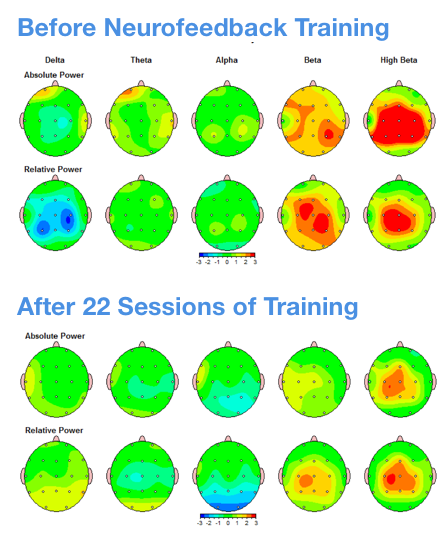
A QEEG map identifies areas of over-activity (red) and under-activity (blue) compared to a healthy normative database.
Your Neurofeedback Journey: What to Expect
1. Passive Monitoring
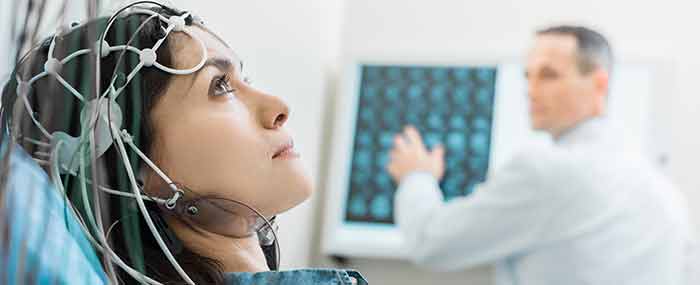
Small sensors are placed on the scalp using the International 10-20 system. These sensors do not put electricity into the brain; they only listen.
2. The Feedback Reward
You sit in a comfortable chair and watch a movie. When your brain hits the target frequencies, the movie plays. If it drifts, the movie dims. Your brain learns to "win."
3. Permanent Change
Lasting neuroplasticity requires commitment. Significant, permanent shifts typically require 20 to 40 sessions, usually held 1-2 times per week.
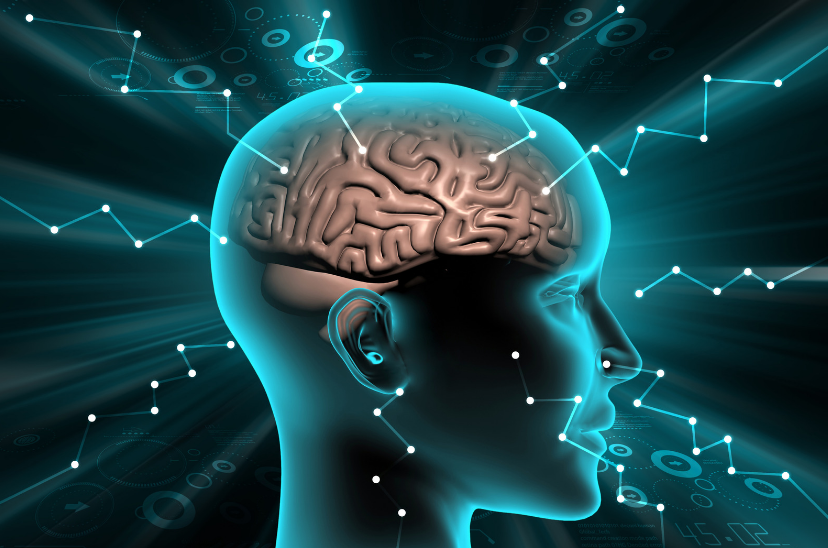
How neurofeedback Transforms The Brain.
Neurofeedback provides real-time data about brain waves in response to different images, skills, tasks, and activities. People undergoing this treatment may be asked to perform tasks like reading, solving math problems, watching videos, or listening to music. During these activities, their brain wave patterns are monitored, recorded, and made available. When abnormal brain waves are detected, the computer may automatically redirect them to a different task or activity.
A key to understanding how neurofeedback works is the concept of neuroplasticity, which describes how the human brain is continuously learning and changing in response to experiences, environment, and choices. It utilizes the same learning process that occurs whenever we acquire a new skill. The brain learns by forming connections between nerve cells and utilizing important pathways that connect different locations in the brain. The more frequently you utilize these pathways the better the brain becomes at performing the associated task. In psychology, this type of leaning is called “Operant Conditioning”. It is a type of learning in which responses come to be controlled by their consequences. Quite simply, Neurofeedback offers the perfect learning conditions, since it facilitates awareness of when the brain is producing healthier brainwave patterns, provides reinforcement for the positive change and multiple opportunities to provide practice during a training session.
Over time, the brain can be conditioned to solidify new neural pathways, leading to lasting changes. This has been demonstrated in certain studies showing that between 70-80% of people treated with neurofeedback experienced a dramatic improvement in symptoms, including 80-85% reduction in symptoms. These results were maintained in post treatment follow ups of 6 months, a year, and sometimes even several years.
Schedule An Appointment
Ready to Start Your Brain Training?
Available at our Ogden and Holladay (SLC) locations. Discover the integrated approach of Leslie and Scott Beatty.
Schedule Your ConsultationThe Process Of neurofeedback
Your brain weighs about 2 pounds, yet it utilizes almost 50% of all of your body’s blood glucose. It utilizes all of this glucose to create electrochemical energy, or simply electricity, to enable your brain to carry out all of its functions, including learning and emotional regulation. This electrical activity can be recorded in the form of brainwaves by placing passive non-invasive electrodes (sensors) on the head. Brainwaves occur at different frequencies, from the slow brainwaves, Delta and Theta to the fast brainwaves, Beta, as measured in cycles per second.
Slow brainwaves (Delta) reflect the brain is under-aroused or functioning at reduced capacity for mental efficiency. This occurs during sleep and daydreaming. When your brain is producing predominantly fast brainwaves (Beta), it is more fully aroused; you are alert, focused, and networks of neurons in the brain are engaged to fully process information.
The faster brainwaves (Beta) need to be dominant for controlling attention, behavior, emotions, and learning. If you are producing too much of the slow brainwaves (Delta or Theta) or too few of the fast brainwaves (Beta), then your brain will be operating at reduced capacity.
Neurofeedback training/treatment is simply brainwave biofeedback. With neurofeedback training, you can learn to improve and strengthen your brainwave patterns to the more dominant faster brainwaves essential for focus, organization, follow through, and basic learning functions.
At the beginning of your treatment process, we will first conduct a QEEG, which records brainwave patterns from all over your head to detect if any regions are malfunctioning. Next, we’ll place 1 or 2 electrodes (sensors) on your scalp over the abnormal area and record your brainwaves, displaying them on a computer screen in the form of a game.
Normally, we cannot accurately influence our brainwave patterns because they are beyond our level of awareness. But when you see your brainwaves on a computer screen in front of you, almost instantaneously as they occur, you will be able to influence them in a positive direction. For example, one of our neurofeedback treatments converts your brainwaves into a computer game of a car driving down the highway. The moment you cause your brainwaves to shift to a faster, healthier frequency, the car begins to speed up on the computer screen and an auditory tone goes off. The auditory tone is triggered every half second you sustain this improved “response”.

Frequently Asked Questions
A: Yes, it is non-invasive and drug-free, making it a popular choice for parents in Utah looking for ADHD support without medication side effects.
A: While every brain is unique, most clients see noticeable changes in sleep and focus within 8-10 sessions, with 20-40 sessions recommended for permanent results.
A: No. Neurofeedback can be done alongside medication. Many clients find they can work with their doctors to reduce dosages once their brain begins to self-regulate more effectively.
A: Neurofeedback is a non-invasive, drug-free process, and side effects are rare and typically very mild. Some clients report feeling "tired" or having a slight "mental fog" immediately following a session—similar to the feeling after an intense workout or a long day of studying. These effects usually dissipate within a few hours. Because no electricity or chemicals are being put into the brain, it remains one of the safest options for children and sensitive adults.
A: One of the greatest benefits of Neurofeedback is that the results are typically long-lasting. Unlike medication, which only works while it's in your system, Neurofeedback is a form of learning—much like learning to ride a bike. Once your brain internalizes these new, healthier patterns of self-regulation, it generally retains them. Many clients find that they do not need "maintenance" sessions once their initial training plan (usually 20–40 sessions) is complete.
A: While most insurance companies currently classify Neurofeedback as "alternative" or "investigational," many of our clients successfully use their HSA (Health Savings Account) or FSA (Flexible Spending Account) to cover costs. For traditional insurance, we can provide you with a "Superbill" (an itemized receipt with medical coding) that you can submit for potential out-of-network reimbursement. We recommend contacting your provider to ask if they cover CPT code 90901 (Biofeedback).
Is Neurofeedback Right For You?
You don't have to navigate your mental health journey alone. Whether you are seeking relief from ADHD, anxiety, or chronic stress, our brain-based approach offers a drug-free way to regain control and find lasting calm.At Healing Tree Counseling, we start every journey with a conversation. We’ll answer your questions about the science, discuss your specific goals, and help you determine if EEG Brain Training is the best fit for your needs.
Click the Button below to schedule a free consultation or call us at 801-215-9002